Corporate governance
Van Oord is committed to upholding high standards of corporate governance. We actively seek to strengthen our governance practices, ensuring transparency and accountability.
The company’s management and supervision are organised under Dutch law in a two-tier system, comprising an Executive Committee and a Supervisory Board.
Executive Committee
The Executive Committee consists of 2 statutory directors (CEO and CFO), the Chief People Officer and the Managing Directors of the 2 business units. It is responsible for the corporate governance structure and for the overall management of the company, in line with the interests of the company and its associated operations, and its stakeholders. The Executive Committee is accountable to the Supervisory Board and the General Meeting of Shareholders.
The Executive Committee is also responsible for defining and executing the strategy, complying with all relevant legislation, managing risks associated with operations and the company’s finances and reporting on these matters. It meets at least once a month. The Executive Committee also discusses internal risk management and monitoring systems with the Supervisory Board.
The company applies a mitigated large company regime. Accordingly, the General Meeting of Shareholders appoints the statutory directors of Van Oord N.V. In the event of a vacancy, the Supervisory Board proposes a candidate for appointment by the General Meeting of Shareholders. Executive Committee members, not being statutory directors, are appointed by the statutory directors of Van Oord N.V., upon approval of the Supervisory Board.
The remuneration and terms of employment of all Executive Committee members are adopted by or aligned with the Supervisory Board.
Supervisory Board
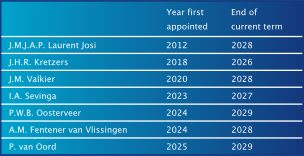
The Supervisory Board supervises the Executive Committee and the general course of events in the company and its operations. It also advises the Executive Committee. The Supervisory Board focuses on strategic, operational and other interests while considering the interests of the company’s stakeholders as relevant and appropriate.
The Supervisory Board has at least 5 members and meets at least 4 times a year. The Supervisory Board has a separate Audit & Risk Committee, a Human Resources Committee, a Large Capital Expenditure Committee and a Tender Committee. The General Meeting of Shareholders determines the remuneration of the Supervisory Board, which is not based on the company’s financial results.
Conflicts of interest
If a conflict of interest arises involving a member of the Executive Committee and/or Supervisory Board, the procedure described in Book 2 of the Dutch Civil Code applies.
Limitation schemes
When candidates are nominated for (re)appointment to the Executive Committee or Supervisory Board, the number of positions that they currently fill is considered. The relevant regulatory rules are adhered to.
Diversity in Executive Committee and Supervisory Board
Van Oord strives for diversity and has set gender ambitions for the Executive Committee, Supervisory Board and senior management. The company accounts for this in the chapter The Right People.
General Meeting of Shareholders
The shareholders are involved in the company and participate in decision-making at the General Meeting of Shareholders. The General Meeting of Shareholders influences the Executive Committee and Supervisory Board’s policy and plays a vital role in the company’s system of checks and balances. Executive Committee decisions concerning a major change in the identity or nature of the company or its operations, and other important decisions such as investments exceeding EUR 100 million, are subject to the approval of the shareholders.
Leadership Teams
The company is structured into 2 business units and functional departments, including a Ship Management Department. In 2025, the Ocean Health activities were organised as a separate business line, with financial reporting integrated into the Offshore Energy business unit. The business units are governed by Leadership Teams and supported by the departments. The Leadership Teams are responsible for managing the business units on a strategic and operational level in line with approved strategies and budgets. Each department is governed by a management team.
External auditor
The General Meeting of Shareholders is required to appoint an auditor for the audit of the annual accounts each year. The appointment of the external auditor is listed as a separate item on the agenda for the annual meeting.
Group Internal Audit
The company has an Internal Audit function that focuses on conducting risk-based internal audits on projects and processes to contribute to achieving Van Oord’s strategic objectives. Additionally, the function supports the further strengthening of risk management and internal controls and the intensifying of the awareness of management control.
Works Council
The Works Council represents the employees on the Dutch payroll. It has 23 members and meets at least 6 times a year with the CEO and Chief People Officer. The Works Council has a right to prior consultation on major decisions and measures, and the right of consent on certain changes in terms of employment.
Corporate Governance Code
Companies listed on the Dutch stock exchange are required to report on their compliance with the Corporate Governance Code. The principles set out in the code also provide standards of good internal governance for other organisations. Although Van Oord is not listed, the company has indicated that, where relevant, it endorses these principles as much as possible.
